Sunday, September 11, 2011

Jewish Naqba النكبة /Catastrophe (Videos)
Jewish Naqba النكبة /Catastrophe (Videos)

I would like to recommend the below videos, which gives us some history regarding the pogroms and other atrocities incurred by Jews residing in Muslim countries. Jewish people living in Muslim countries were never treated as equal, but as sub-humans, as “second-class citizens” under state-sponsored discrimination and actively persecuted by Islamic militants apart from the government.
Those Jews from New York, Los Angeles, and Montreal are not unfamiliar with Persian, Syrian, Moroccan, and even Yemenite Jewish culture and history. Yet, most others still appear to be rather ignorant of their existence, let alone their histories, which which has paralleled their own.
Some people tent to think that Jewish people in Muslim countries had an easy life, compare to those in Europe. Think again.
In the 1940s, close to a million Jews from Arab countries were expelled from lands in which they had lived for 3000 years. They lost billions of dollars in property and came penniless to Israel. While we hear so much about the "Palestinian" refugees, the plight of the Mizrahi Jews has all but been forgotten.
An estimated 850,000 Jews were ethnically cleansed from Arab/Muslim lands. All were absorbed.
The Jewish exodus from Arab lands refers to the 20th century expulsion or mass departure of Jews, primarily of Sephardi and Mizrahi background, from Arab and Islamic countries. The migration started in the late 19th century, but accelerated after the 1948 Arab-Israeli War.
About 800,000 to 1,000,000 Jews were either forced out or fled their homes in Arab countries from 1948 until the early 1970s; 260,000 reached Israel in 1948-1951, 600,000 by 1972. The Jews of Egypt and Libya were expelled while those of Iraq, Yemen, Syria, Lebanon and North Africa left as a result of a coordinated effort among Arab governments to create physical and political insecurity. Most were forced to abandon their property. By 2002 these Jews and their descendants constituted about 40% of Israel’s population. One of the main representative bodies of this group, the World Organization of Jews from Arab Countries, (WOJAC) estimates that Jewish property abandoned in Arab countries would be valued today at more than $300 billion and Jewish-owned real-estate left behind in Arab lands at 100,000 square kilometers (four times the size of the State of Israel). The organization asserts that the Jewish exodus was the result of a deliberate policy decision taken by the Arab League.
To read more about the Jewish Naqba go here
“Why does the Torah start with the creation, instead of the first commandment given to the Jewish People? Because if the nations of the world ever accuse the Jews of stealing the Land of Israel, the Jews will be able to respond to the nations of the world that the entire world belongs to G-d, He created it and He choose to give the Land of Israel to the Jewish People.” -Rabbi Shlomo ben Yitzhak (Rashi)
AMAZING PICTURES OF THE JEWISH NAQBA…….
AMAZING PICTURES OF THE JEWISH NAQBA…….
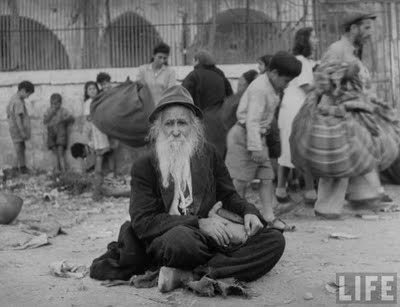
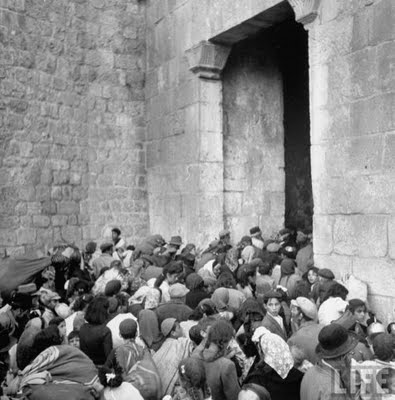
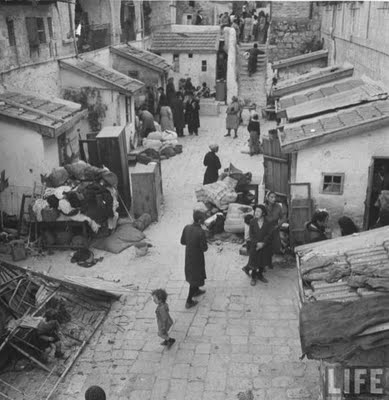
Thanks to Joe Settler at The Muqata for the following pics who has much more at his site. The Arabs were not the only ones (many Arabs opted for leaving at the behest of their leaders) who had to flee the fighting, Jews were forced to vacate E.Jerusalem in droves. This needs to be hammered on, the Arabs and their apologists have managed to cloud the issues surrounding refugees long enough. KGS
Jewish refugees leaving their area of J’lem in the wake of the fighting.
Jews fleeing through the Zion Gate
Jews preparing to evacuate their homes
 The area after the Arabs got there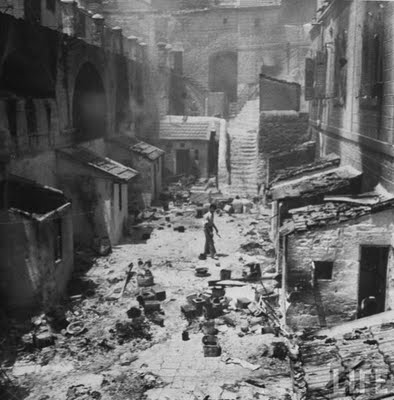
Remembering the ‘Farhud’
Remembering the ‘Farhud’
By ZVI GABAY

As more and more Arabs recognize that they are not the only victims of the Mideast conflict, the dialogue with Israel can take place on a more genuine basis.
On June 1, Iraqi Jews commemorated the 70th anniversary of the farhud – anti-Jewish riots that took place on Shavuot, 1941. In the riots, reminiscent of Krystallnacht in Germany, at least 137 Jews – men, women and children – were murdered, hundreds more were injured, and much Jewish property was looted. The memory of the riots remains fresh in the minds of Iraqi Jews.
The attacks occurred without any provocation. The Jews, who had lived in Arab lands for thousands of years, did not declare war on their hosts. They never fought against them, as the Arabs in Mandatory Palestine fought against Jewish settlements and afterward against the nascent Jewish state.
The world has heard a great deal about the injustice that happened to the Palestinians, under the code name nakba, but knows almost nothing about the wrongs committed against the Jews of Arab lands. What happened in the Arab countries was in effect an ethnic cleansing.
While the Palestinian nakba is marked every year with demonstrations and wide media coverage, the “Jewish nakba” merits little notice. This, despite the fact that the human and physical dimensions of the disaster were larger. The number of Jews forced out of their homes with nothing but the clothes on their backs was about 856,000, while the Arabs who left Mandatory Palestine numbered about 650,000. The UN, in Resolution 302 adopted in December 1949, established UNRWA – an agency in charge of relief and education only; not of rehabilitation. This policy did not diminish the number of Palestinian refugees, which has reached 4.8 million (including two million who became Jordanian citizens).
ISRAEL, FOR unclear reasons, did not raise the tragedy of the Jews from Arab countries on its political and public agendas.
Only on February 22, 2010, was the issue placed on the Israeli agenda with the enactment of “The Law for Preservation of the Rights to Compensation of Jewish Refugees from Arab Countries and Iran,” which states that any negotiation for the achievement of peace in the Middle East must include compensation for said Jews.
The attacks against the Jews of Arab lands occurred even before the establishment of Israel. In Iraq, they began with discrimination in the economy, education and public life.
Afterward, Arab nationalism ignited the fires of rioting against the Jews, which came to a peak in the farhud of 1941. Similar tragedies happened to the Jews of Libya and Aden. In a wave of pogroms in Libya in November 1945, 133 Jews were killed and 400 wounded; synagogues, businesses and homes were looted and destroyed. In Aden, even though it was under British rule, 100 Jews were murdered in November 1947 and many more wounded; hundreds of homes were destroyed.
Similar pogroms occurred in Egypt, in Syria and the rest of the Arab countries, since they achieved independence during the 20th century.
The combination of xenophobic Sunni nationalism – which is intolerant of all others, including Shi’ites, Christians and Kurds – and anti-Semitism produced a powerful hatred of the Jews. This hatred was abetted by Nazis such as the German envoy to Baghdad, Dr. Fritz Grobba, and pseudo-religious leaders such as Haj Amin al-Husseini (who fled from Mandatory Palestine and found in Iraq a convenient venue for his anti-Jewish activities). The Jews were left with no choice but to flee from the Arab countries that they had helped to found and to bring into the modern era with their contributions to government, the economy, medicine, education, literature, poetry and music.
The threatening anti-Jewish climate that prevailed in every Arab land was accompanied by inflamed anti-Jewish declarations, even from the podium of the United Nations.
Eliyahu Nawi, a commentator on Israel’s Arabic-language radio station, testified that following the 1947 Partition Resolution at the UN, Arabic radio stations constantly broadcast the song “Halu a-Saif Ygul” – “Let the sword speak... to thin out the cousins [the Jews].”
Government harassment and popular attacks drove the Jews of the Arab world to migrate en masse, (mostly to Israel, where they were given citizenship and successfully integrated into society). In Egypt, a mass expulsion took place in the dead of night; the Jews were forced to leave their personal and communal property – including schools, ancient synagogues and cemeteries, prophets’ graves and hospitals. The Arab authorities confiscated the property and used it for their own needs.

There were certainly Muslims in the Arab countries who did not support these attacks, but their voices were not heard. The Jews were the scapegoats in internecine power struggles between the Sunnis and the Shi’ites, just as today Israel is at the center of the struggle between Shi’ite Iran and the Sunni states, with Turkey at the fore.
In recent years, a process of awakening can be discerned in the Arab world, especially among intellectuals, who recognize that it was not only the Palestinian Arabs who suffered a nakba; the Jews of the Arab world had their own catastrophe.
In Israel, a commemoration ceremony will held on June 6 at the Babylonian Jewish Center in Or Yehuda.
The writer is a former ambassador and deputy director general of the Foreign Ministry.
= = =
Despite the valiant efforts of Arab deniers, the story of the Arab ethnic cleansing of Jews from the Arab League countries is becoming more and more widely known.
While the whole world knows of the 650,000 Palestinian Arabs who became refugees (some willingly, some not), few recognize the other side of the same conflict—where 900,000 Jews, living peacefully in Arab lands, were expelled through an Arab League states agreed-upon policy of legislation, oppression, persecution and thievery. Even Hitler never managed to make Germany as “Jew-free” as the Arab states have managed to make themselves—from 900,000 in 1948 to less than 10,000 in 2010.
Can any logical human being really believe the Arab claim that ALL 900,000 left because of “idealistic reasons”, leaving billions of (1948) dollars and hundreds of thousands of square kilometers of land behind them with no compensation? Most of them went to Israel, a country that had just managed to survive a war intended to eradicate it, with an uncertain future and constantly under the threat of more wars?
If you can believe that, you’ll believe that I can sell you the Tower Bridge in London.
By ZVI GABAY
As more and more Arabs recognize that they are not the only victims of the Mideast conflict, the dialogue with Israel can take place on a more genuine basis.
On June 1, Iraqi Jews commemorated the 70th anniversary of the farhud – anti-Jewish riots that took place on Shavuot, 1941. In the riots, reminiscent of Krystallnacht in Germany, at least 137 Jews – men, women and children – were murdered, hundreds more were injured, and much Jewish property was looted. The memory of the riots remains fresh in the minds of Iraqi Jews.
The attacks occurred without any provocation. The Jews, who had lived in Arab lands for thousands of years, did not declare war on their hosts. They never fought against them, as the Arabs in Mandatory Palestine fought against Jewish settlements and afterward against the nascent Jewish state.
The world has heard a great deal about the injustice that happened to the Palestinians, under the code name nakba, but knows almost nothing about the wrongs committed against the Jews of Arab lands. What happened in the Arab countries was in effect an ethnic cleansing.
While the Palestinian nakba is marked every year with demonstrations and wide media coverage, the “Jewish nakba” merits little notice. This, despite the fact that the human and physical dimensions of the disaster were larger. The number of Jews forced out of their homes with nothing but the clothes on their backs was about 856,000, while the Arabs who left Mandatory Palestine numbered about 650,000. The UN, in Resolution 302 adopted in December 1949, established UNRWA – an agency in charge of relief and education only; not of rehabilitation. This policy did not diminish the number of Palestinian refugees, which has reached 4.8 million (including two million who became Jordanian citizens).
ISRAEL, FOR unclear reasons, did not raise the tragedy of the Jews from Arab countries on its political and public agendas.
Only on February 22, 2010, was the issue placed on the Israeli agenda with the enactment of “The Law for Preservation of the Rights to Compensation of Jewish Refugees from Arab Countries and Iran,” which states that any negotiation for the achievement of peace in the Middle East must include compensation for said Jews.
The attacks against the Jews of Arab lands occurred even before the establishment of Israel. In Iraq, they began with discrimination in the economy, education and public life.
Afterward, Arab nationalism ignited the fires of rioting against the Jews, which came to a peak in the farhud of 1941. Similar tragedies happened to the Jews of Libya and Aden. In a wave of pogroms in Libya in November 1945, 133 Jews were killed and 400 wounded; synagogues, businesses and homes were looted and destroyed. In Aden, even though it was under British rule, 100 Jews were murdered in November 1947 and many more wounded; hundreds of homes were destroyed.
Similar pogroms occurred in Egypt, in Syria and the rest of the Arab countries, since they achieved independence during the 20th century.
The combination of xenophobic Sunni nationalism – which is intolerant of all others, including Shi’ites, Christians and Kurds – and anti-Semitism produced a powerful hatred of the Jews. This hatred was abetted by Nazis such as the German envoy to Baghdad, Dr. Fritz Grobba, and pseudo-religious leaders such as Haj Amin al-Husseini (who fled from Mandatory Palestine and found in Iraq a convenient venue for his anti-Jewish activities). The Jews were left with no choice but to flee from the Arab countries that they had helped to found and to bring into the modern era with their contributions to government, the economy, medicine, education, literature, poetry and music.
The threatening anti-Jewish climate that prevailed in every Arab land was accompanied by inflamed anti-Jewish declarations, even from the podium of the United Nations.
Eliyahu Nawi, a commentator on Israel’s Arabic-language radio station, testified that following the 1947 Partition Resolution at the UN, Arabic radio stations constantly broadcast the song “Halu a-Saif Ygul” – “Let the sword speak... to thin out the cousins [the Jews].”
Government harassment and popular attacks drove the Jews of the Arab world to migrate en masse, (mostly to Israel, where they were given citizenship and successfully integrated into society). In Egypt, a mass expulsion took place in the dead of night; the Jews were forced to leave their personal and communal property – including schools, ancient synagogues and cemeteries, prophets’ graves and hospitals. The Arab authorities confiscated the property and used it for their own needs.
There were certainly Muslims in the Arab countries who did not support these attacks, but their voices were not heard. The Jews were the scapegoats in internecine power struggles between the Sunnis and the Shi’ites, just as today Israel is at the center of the struggle between Shi’ite Iran and the Sunni states, with Turkey at the fore.
In recent years, a process of awakening can be discerned in the Arab world, especially among intellectuals, who recognize that it was not only the Palestinian Arabs who suffered a nakba; the Jews of the Arab world had their own catastrophe.
Arab leaders – Palestinians and others – would do well to stop parroting the slogan “the right of return” and deluding their people, because there is no turning back time.As more and more Arabs recognize that they are not the only victims of the Middle East conflict, the dialogue with Israel can take place on a more genuine basis of justice.
In Israel, a commemoration ceremony will held on June 6 at the Babylonian Jewish Center in Or Yehuda.
The writer is a former ambassador and deputy director general of the Foreign Ministry.
= = =
Despite the valiant efforts of Arab deniers, the story of the Arab ethnic cleansing of Jews from the Arab League countries is becoming more and more widely known.
While the whole world knows of the 650,000 Palestinian Arabs who became refugees (some willingly, some not), few recognize the other side of the same conflict—where 900,000 Jews, living peacefully in Arab lands, were expelled through an Arab League states agreed-upon policy of legislation, oppression, persecution and thievery. Even Hitler never managed to make Germany as “Jew-free” as the Arab states have managed to make themselves—from 900,000 in 1948 to less than 10,000 in 2010.
Can any logical human being really believe the Arab claim that ALL 900,000 left because of “idealistic reasons”, leaving billions of (1948) dollars and hundreds of thousands of square kilometers of land behind them with no compensation? Most of them went to Israel, a country that had just managed to survive a war intended to eradicate it, with an uncertain future and constantly under the threat of more wars?
If you can believe that, you’ll believe that I can sell you the Tower Bridge in London.
THE LAST JEWS OF LIBYA
In the presence of the film maker Vivienne Roumani-Denn
As a teenager in Jerusalem many decades ago, our favourite social game was called "The Elephant and the Jewish Question" the essence of the game was to link any word one might suggest with a Jewish connection even if that was totally tenuous. It was a way of entertainment yet now when I look back at it, I believe that in our psychological makeup we carry the responsibility not to look upon ourselves as individuals but as far as the Jewish collective and care about it. "Kol Yisrael Arevim ze Laze" the dictum which reminds us daily of our collective responsibility to our brethren has become a second nature for us (and was incidentally the official theme of this year's Yom Ha-Atzmaout. This when something dramatic or worrying happens somewhere in the world our first instinct is to find out what actually happens or to the Jews in that place - after all we are members of the same extended family. When all our eyes are turned to Libya and to Khadaffi , his sons and grandchildren we wish to know what happened to the Jews in Libya.
An interesting interview was given about the fate and the history of the Jews of Libya by Dr Joseph Maimon, an electrical engineer who was thrown out of Libya in 67 at the breakout of the 6 days War.
The humiliation of the Arab shameful defeat in that war resulted in pogroms: Jewish shops in the central square in Tripoli were burnt. Jews were afraid to leave their houses knowing that they would be locked and attacked by their neighbours. They could not even go to buy bread or milk. In the 42 days that they were locked in their houses, they were often helped by Italians who were still living in Libya. The same Arabs who were colleagues at work until 67 became foes. Libya announced that they would create camps to gather Jews in then and provide them protection. The first families which left for the camp, one of which families was the Luzon family were murdered as soon as they arrived at the camp. Libya wanted to get rid of their Jews. England and France refused to give their refuge but Italy accepted them. It was relatively easy to integrate in Italy as they spoke Italian.
Every Jew who was allowed to leave could take with them one suitcase of 20kg and the sum of £20. In Italy they were put into refuge camps. All their possessions remained in Libya: shops, factories, property. It amounted to the fortune.
When this issue was raised at one point Khadaffi himself declared that he would compensate those who left behind all that they possessed in his country and even signed a .... Since then nothing of course happened. When Khadaffi visited Italy, Libyan Jews approached him to remind him of this undertaking. Israeli government did not do anything in the matter and there is of course the question of lack of meticulous documentation.
Now, that Palestinians are coming to Israel with demands of compensation for their lost property - this is the right time for the Israeli government in any negations of the kind to raise the topic of Jews from Libya and other Arab countries like Iraq who have left all their houses and fortunes in the countries where their Jewish ancestors lived at time thousands of years.
The film "The Last Jews of Libya" is the last document of a community which is no longer there. In all the news about Libya, it is forgotten that a thriving and ancient community of 36,000 Jews lived there at the end of World War II. Not a single Jew lives there today.
The Last Jews of Libya documents the final decades of the community through the lives of the Roumani family. A tale of war, cultural dislocation, and one Libyan family's perseverance, this 50-minute film traces the story of the Roumanis of Benghazi from Turkish Ottoman rule, through the age of Mussolini and Hitler, to the final destruction and dispersal of Libya's Jews in the face of Arab nationalism.
In the near future when the world's eye is turned to the question of Palestinian refugees, let us take this opportunity and remind ourselves and others about the plight of hundreds of thousands of Jewish refugees who were all led to normal lives by the state of Israel.
As a teenager in Jerusalem many decades ago, our favourite social game was called "The Elephant and the Jewish Question" the essence of the game was to link any word one might suggest with a Jewish connection even if that was totally tenuous. It was a way of entertainment yet now when I look back at it, I believe that in our psychological makeup we carry the responsibility not to look upon ourselves as individuals but as far as the Jewish collective and care about it. "Kol Yisrael Arevim ze Laze" the dictum which reminds us daily of our collective responsibility to our brethren has become a second nature for us (and was incidentally the official theme of this year's Yom Ha-Atzmaout. This when something dramatic or worrying happens somewhere in the world our first instinct is to find out what actually happens or to the Jews in that place - after all we are members of the same extended family. When all our eyes are turned to Libya and to Khadaffi , his sons and grandchildren we wish to know what happened to the Jews in Libya.
An interesting interview was given about the fate and the history of the Jews of Libya by Dr Joseph Maimon, an electrical engineer who was thrown out of Libya in 67 at the breakout of the 6 days War.
The humiliation of the Arab shameful defeat in that war resulted in pogroms: Jewish shops in the central square in Tripoli were burnt. Jews were afraid to leave their houses knowing that they would be locked and attacked by their neighbours. They could not even go to buy bread or milk. In the 42 days that they were locked in their houses, they were often helped by Italians who were still living in Libya. The same Arabs who were colleagues at work until 67 became foes. Libya announced that they would create camps to gather Jews in then and provide them protection. The first families which left for the camp, one of which families was the Luzon family were murdered as soon as they arrived at the camp. Libya wanted to get rid of their Jews. England and France refused to give their refuge but Italy accepted them. It was relatively easy to integrate in Italy as they spoke Italian.
Every Jew who was allowed to leave could take with them one suitcase of 20kg and the sum of £20. In Italy they were put into refuge camps. All their possessions remained in Libya: shops, factories, property. It amounted to the fortune.
When this issue was raised at one point Khadaffi himself declared that he would compensate those who left behind all that they possessed in his country and even signed a .... Since then nothing of course happened. When Khadaffi visited Italy, Libyan Jews approached him to remind him of this undertaking. Israeli government did not do anything in the matter and there is of course the question of lack of meticulous documentation.
Now, that Palestinians are coming to Israel with demands of compensation for their lost property - this is the right time for the Israeli government in any negations of the kind to raise the topic of Jews from Libya and other Arab countries like Iraq who have left all their houses and fortunes in the countries where their Jewish ancestors lived at time thousands of years.
The film "The Last Jews of Libya" is the last document of a community which is no longer there. In all the news about Libya, it is forgotten that a thriving and ancient community of 36,000 Jews lived there at the end of World War II. Not a single Jew lives there today.
The Last Jews of Libya documents the final decades of the community through the lives of the Roumani family. A tale of war, cultural dislocation, and one Libyan family's perseverance, this 50-minute film traces the story of the Roumanis of Benghazi from Turkish Ottoman rule, through the age of Mussolini and Hitler, to the final destruction and dispersal of Libya's Jews in the face of Arab nationalism.
In the near future when the world's eye is turned to the question of Palestinian refugees, let us take this opportunity and remind ourselves and others about the plight of hundreds of thousands of Jewish refugees who were all led to normal lives by the state of Israel.
Recalling the Jewish Nakba in the 'Middle East', W2 - Draiman

Recalling the Jewish Nakba in the 'Middle East', W2
(Top) Some 80 people heard the harrowing stories of refugees from Egypt, Libya and Iraq. (Middle) Tom Gross and Michelle Huberman. (Bottom) Refugee from Iraq Nadia Nathan holds the award presented on Harif's behalf by Tom Gross to Rosemond Nissan for her work with refugees. (Photos: Gili and Niran)
If they want Islamic banking, crave Lebanese mezze at the dozens of restaurants and kebab houses, or hanker for a hookah pipe, the cognoscenti head for the Edgware Road, W2, in London. Here the hijab-clad women and Arabic signage make you feel, for all the world, that you are in the Middle East.
And so it was a trifle daunting - but also appropriate - that Sunday's event concerning the Jews of the Middle East and North Africa, Harif's The Jewish Nakba:remembering Jewish refugees from Arab countries, should have been held in the heart of London's Levant.
The police, however, were taking no chances. Guests had to brave a ring of steely officers on entry to the hotel, going through airport-style security so tight that some bona fide latecomers were turned away. The organisers were not allowed to advertise their meeting lest the expression Jewish Nakba appearing on a hotel screen might incite some hothead with a kebab skewer to go on the rampage.
The date chosen was deliberate: 15 May was Nakba Day for the Palestinians, but it was also an opportunity to tell the world about a second Nakba - the mass displacement of almost a million Jews from the Arab world.
Before an audience of 80 people, Jewish refugees told their harrowing stories. Colette Littman was forced to flee Egypt in 1956 after days of listening to the mob screaming Ytbah al yahud in the streets of Cairo below her apartment.The family's cook Omar was found sharpening a kitchen knife: what was he doing? she asked him. 'Getting ready to kill the Jews', came the reply.
Colette left with only the clothes she was wearing and her suitcase was ransacked at the airport. Not only did Egyptian Jews face an uncertain future in exile, but they underwent the emotional trauma of seeing their communities destroyed and their families scattered to the ends of the earth.
Elia Meghnagi left Benghazi in Libya in 1958 to study abroad. His early memories are of brawls between Arab and Jewish youths. As a stateless student in England, he was forced to support himself. Later, he arranged for his family to join him, but they had to leave all their property and belongings behind. They quietly slipped out, leaving the table set as if for a meal so as not to arouse the neighbours' suspicions. Back in England, visiting the Libyan embassy in order to regularise his status, Elia narrowly escaped being bundled into a plane and forcibly returned to Libya.
Edwin Shuker's family had lived in Mesopotamia - now Iraq - for 2,700 years. One of five thousand Jews still left in the country after the mass exodus of 1950 -51, Edwin witnessed the noose tightening around the community's necks in the sixties, when Jews had to carry yellow identity papers. Then came the horrific hangings of 1969, when a mob half a million strong picknicked under the corpses of nine innocent Jews suspended from the gallows in the main square. Edwin's family had to leave like thieves in the night, abandoning 2,700 years of history behind them.
Dr Saul Zadka, academic, author and journalist, who described himself as a 'refugee at heart', gave an incisive political analysis of the refugee issue. The two cases were quite different. Some 100,000 Palestinian 'refugees' belonging to well-to-do families left the country a year earlier with their money and belongings with every intention of returning when the Jews had been crushed. A million Arabs, many of them hostile to Israel, lived as full citizens with more rights than any of their fellow countrymen in Arab states. Jews in Arab lands were loyal citizens, yet were rewarded with murderous riots in Iraq, Libya and Aden before the creation of Israel. It was a hopeful development that the US Congress had passed a resolution in 2008 demanding parity between Jewish and Palestinian refugees, but the Israeli government was still doing too little, too late. Dr Zadka himself distributed a statement to the audience demanding that Jewish refugee rights be recognised and compensation for property many times more valuable than Palestinian losses, as the Jews were big city dwellers while the Palestinians were largely poor farmers who supported the invading armies.
Following a showing of the 15-minute short version of the film 'Forgotten Refugees', the international relations expert Tom Gross said that the Jewish refugee issue was in many ways the single most important issue on the Middle East agenda. " In theory Borders can be agreed and Jerusalem can be divided, but there is no answer to appeasing the feelings and demands of Palestinians and their supporters regarding the so-called 'right of return' - apart from making them aware of the suffering and the loss of the refugees of the Jewish Nakba, " he said. Yet few knew about it - and he seriously doubted if Prime Minister David Cameron and Foreign Secretary William Hague had even heard of it. As far as Israel advocacy was concerned, no session at the 'We believe in Israel' conference taking place that day dealt with the topic. As for the press and media, they were mesmerised with the Palestinian Nakba to the exclusion of other news and other refugees.
On behalf of Harif, Tom Gross presented an award to Mrs Rosemond Nissan, who had devoted 33 years to helping refugees from the Middle East at World Jewish Relief. Michelle Huberman spoke of what tools could be used to promote Jewish refugees: she unveiled Harif's new Mezuzah campaign, recalling the stolen Jewish homes in Arab lands - every activist's must-have accessory.
As they stepped back out on to the Edgware Road, the ex-refugees in the audience went away fired up with renewed enthusiasm to tell their stories. Indignant Israel advocates prepared to vent their outrage at this neglected issue in letters to the editor - and the hungry simply went off in search of a hummus and pitta in London's 'Middle East'.
If they want Islamic banking, crave Lebanese mezze at the dozens of restaurants and kebab houses, or hanker for a hookah pipe, the cognoscenti head for the Edgware Road, W2, in London. Here the hijab-clad women and Arabic signage make you feel, for all the world, that you are in the Middle East.
And so it was a trifle daunting - but also appropriate - that Sunday's event concerning the Jews of the Middle East and North Africa, Harif's The Jewish Nakba:remembering Jewish refugees from Arab countries, should have been held in the heart of London's Levant.
The police, however, were taking no chances. Guests had to brave a ring of steely officers on entry to the hotel, going through airport-style security so tight that some bona fide latecomers were turned away. The organisers were not allowed to advertise their meeting lest the expression Jewish Nakba appearing on a hotel screen might incite some hothead with a kebab skewer to go on the rampage.
The date chosen was deliberate: 15 May was Nakba Day for the Palestinians, but it was also an opportunity to tell the world about a second Nakba - the mass displacement of almost a million Jews from the Arab world.
Before an audience of 80 people, Jewish refugees told their harrowing stories. Colette Littman was forced to flee Egypt in 1956 after days of listening to the mob screaming Ytbah al yahud in the streets of Cairo below her apartment.The family's cook Omar was found sharpening a kitchen knife: what was he doing? she asked him. 'Getting ready to kill the Jews', came the reply.
Colette left with only the clothes she was wearing and her suitcase was ransacked at the airport. Not only did Egyptian Jews face an uncertain future in exile, but they underwent the emotional trauma of seeing their communities destroyed and their families scattered to the ends of the earth.
Elia Meghnagi left Benghazi in Libya in 1958 to study abroad. His early memories are of brawls between Arab and Jewish youths. As a stateless student in England, he was forced to support himself. Later, he arranged for his family to join him, but they had to leave all their property and belongings behind. They quietly slipped out, leaving the table set as if for a meal so as not to arouse the neighbours' suspicions. Back in England, visiting the Libyan embassy in order to regularise his status, Elia narrowly escaped being bundled into a plane and forcibly returned to Libya.
Edwin Shuker's family had lived in Mesopotamia - now Iraq - for 2,700 years. One of five thousand Jews still left in the country after the mass exodus of 1950 -51, Edwin witnessed the noose tightening around the community's necks in the sixties, when Jews had to carry yellow identity papers. Then came the horrific hangings of 1969, when a mob half a million strong picknicked under the corpses of nine innocent Jews suspended from the gallows in the main square. Edwin's family had to leave like thieves in the night, abandoning 2,700 years of history behind them.
Dr Saul Zadka, academic, author and journalist, who described himself as a 'refugee at heart', gave an incisive political analysis of the refugee issue. The two cases were quite different. Some 100,000 Palestinian 'refugees' belonging to well-to-do families left the country a year earlier with their money and belongings with every intention of returning when the Jews had been crushed. A million Arabs, many of them hostile to Israel, lived as full citizens with more rights than any of their fellow countrymen in Arab states. Jews in Arab lands were loyal citizens, yet were rewarded with murderous riots in Iraq, Libya and Aden before the creation of Israel. It was a hopeful development that the US Congress had passed a resolution in 2008 demanding parity between Jewish and Palestinian refugees, but the Israeli government was still doing too little, too late. Dr Zadka himself distributed a statement to the audience demanding that Jewish refugee rights be recognised and compensation for property many times more valuable than Palestinian losses, as the Jews were big city dwellers while the Palestinians were largely poor farmers who supported the invading armies.
Following a showing of the 15-minute short version of the film 'Forgotten Refugees', the international relations expert Tom Gross said that the Jewish refugee issue was in many ways the single most important issue on the Middle East agenda. " In theory Borders can be agreed and Jerusalem can be divided, but there is no answer to appeasing the feelings and demands of Palestinians and their supporters regarding the so-called 'right of return' - apart from making them aware of the suffering and the loss of the refugees of the Jewish Nakba, " he said. Yet few knew about it - and he seriously doubted if Prime Minister David Cameron and Foreign Secretary William Hague had even heard of it. As far as Israel advocacy was concerned, no session at the 'We believe in Israel' conference taking place that day dealt with the topic. As for the press and media, they were mesmerised with the Palestinian Nakba to the exclusion of other news and other refugees.
On behalf of Harif, Tom Gross presented an award to Mrs Rosemond Nissan, who had devoted 33 years to helping refugees from the Middle East at World Jewish Relief. Michelle Huberman spoke of what tools could be used to promote Jewish refugees: she unveiled Harif's new Mezuzah campaign, recalling the stolen Jewish homes in Arab lands - every activist's must-have accessory.
As they stepped back out on to the Edgware Road, the ex-refugees in the audience went away fired up with renewed enthusiasm to tell their stories. Indignant Israel advocates prepared to vent their outrage at this neglected issue in letters to the editor - and the hungry simply went off in search of a hummus and pitta in London's 'Middle East'.
Thursday, September 8, 2011
Jewish Refugees from Arab Countries:
Jewish Refugees from Arab Countries:
INTRODUCTION
When the issue of refugees is raised within the context of the Middle East, people invariably refer to Palestinian refugees, virtually never to Jews displaced from Arab countries.
In reality, two major population movements occurred as a result of over a half century of turmoil in the Middle East. Securing rights for these former Jewish refugees has never been adequately addressed by the international community. For any peace process to be credible and enduring, it must address the rights of all Middle East refugees, including Jewish and other minority populations that were displaced from Arab countries.
Historically, Jews and Jewish communities have existed in the Middle East, North Africa and the Gulf region for more than 2,500 years. Jews in substantial numbers resided in what are to-day Arab countries over 1,000 years before the advent of Islam. Following the Moslem conquest of the region, for centuries, while relegated to second-class status, Jews were nonetheless permitted limited religious, educational, professional, and business opportunities.
It is important to note that the treatment of Jews by Arab leaders and Islamic populations varied greatly from country to country. By way of example, in some countries, Jews were forbidden to leave (e.g. Syria); in others, many Jews were expelled (e.g. Egypt) or displaced en masse (e.g. Iraq); while other Jewish communities lived in relative peace under the protection of Muslim rulers (e.g. Tunisia, Morocco).
When Arab countries gained independence, followed by the rise in Arab nationalism, state-sanctioned measures, coupled often with violence and repression, made remaining in the land of their birth an untenable option for Jews.
In 1948, the status of Jews in Arab countries worsened dramatically as many Arab countries declared war, or backed the war against the newly founded State of Israel. Jews were either uprooted from their countries of longtime residence or became subjugated, political hostages of the Arab-Israeli conflict. In virtually all cases, as Jews left the country, individual and communal properties were confiscated without compensation.
Since 1948, over 850,000 Jews have left their birthplaces and their homes in some 10 Arab countries. To-day, fewer than 7,000 Jews remain in these same countries.
The fact that Jews displaced from Arab countries were indeed bone fide refugees, under international law, is beyond question.
• On two separate occasions the United Nations High Commissioner for Refugees (UNHCR)
ruled that Jews fleeing from Arab countries were indeed ‘bona fide’ refugees who “fall under the mandate of my (UNHCR) office”.1
1 Mr. Auguste Lindt, United Nations High Commissioner for Refugees, Report of the UNREF Executive Committee, Fourth Session – Geneva 29 January to 4 February, 1957; and Dr. E. Jahn, Office of the UN High Commissioner, United Nations High Commissioner for Refugees, Document No. 7/2/3/Libya, July 6, 1967.
3
• In all relevant international bilateral or multilateral agreements, (i.e., UN Resolution 242, The Road Map, The Madrid Conference, etc.), the reference to “refugees” is generic, allowing for the recognition and inclusion of all Middle East refugees - Jews, Christians, and other minorities.
This Legal Report is intended to document, and assert, the rights of Jews displaced from Arab countries. Justice for Jewish refugees from Arab countries must assume its rightful place on the international political agenda, as a matter of law and equity.
It is important to underscore that:
1) The legitimate call to secure rights and redress for Jews displaced from Arab countries is not a campaign against Palestinian refugees. In any Middle East peace proposals, Palestinian refugees will be up for discussion. The history and truth about the plight of former Jewish refugees from Arab countries must be also be acknowledged and returned to the narrative of the Middle East from which it has been expunged;
2) This Report should not be misconstrued as ‘anti-Arab’. This Report provides an accurate historical narrative about the plight and flight of Jews from Arab countries that has never been recognized by the international community nor acknowledged by Arab countries. Compelling evidence supports the call for justice to redress the victimization of Jews who lived in Arab countries and the mass violations of human rights that they were victims of; and
3) This initiative is not about money, nor about launching legal proceedings to seek compensation. This Report provides legal facts and evidence to assist all parties in any future negotiations on rights and redress for all Middle East refugees. In the absence of truth and justice, there can be no reconciliation, without which there can be no just, lasting peace between and among all peoples of the region.
The first injustice was the mass violations of rights of Jews in Arab countries. To-day, we must not allow a second injustice – for the international community to recognize rights for one victim population - Palestinian refugees - without recognizing equal rights for other victims of that very same Middle East conflict - former Jewish, Christian and other refugees from Arab countries.
EXECUTIVE SUMMARY
A) Why Now?
Why has justice for Jewish refugees not only been delayed, but why has it been denied all these years?
Why has the issue been absent, not only from the international justice agenda, but why has it also been absent all these years from the Middle East peace agenda?
Why is it that the U.N. is preparing, yet again, to commemorate the International Day of Solidarity with the Palestinian People – on the 60th anniversary of the U.N. Partition Resolution of 1947 – but will ignore, yet again, the plight of Jewish refugees on that commemorative occasion?
Let there be no doubt about it: where there is no remembrance, there is no truth; where there is no truth, there will be no justice; where there is no justice, there will be no reconciliation; and where there is no reconciliation, there will be no peace.
There are a number of compelling, indeed urgent, moral and juridical considerations whose convergence warrants the publication of this Report.
First, there is the importance of rectifying the distorted historical narrative of Middle East refugees, and redressing the painful and pernicious delay and denial of justice for Jewish refugees these past sixty years. In particular, Jewish refugees from Arab countries must be restored to the Middle East narrative from which they have been expunged and eclipsed.
Second, there is the importance of the right to memory and the duty of remembrance of Jewish refugees; the importance for the refugees themselves of bearing witness; and the importance of hearing and documenting this witness testimony.
Third, there is the need to lay bare the truth, to counter the Middle East revisionism and distortion, to expose the cover-up of the historical narrative; and to combat the corruption of truth that inhibits understanding and prevents validation of a victim population, their history, their experience, and their pain.
Fourth, this Report not only details this pattern of state-sanctioned repression of Jews throughout Arab countries, but uncovers, for the first time, evidence of an international criminal conspiracy by the League of Arab States to persecute its own Jewish populations, as set forth more fully in Chapter 2 of this report.
Fifth, there are important developments in international human rights and humanitarian law, where more has happened in the last 15 years than in the previous sixty, which now underpin a right of redress for victim populations, and which apply specifically to the case of Jewish refugees from Arab countries.
Sixth, there is now a panoply of remedies to implement the right of redress in international law. These are not limited to compensation or indemnification of a victim population, but include such components as the right of memory, the duty of remembrance, the search for truth, access to justice, state-responsibility for wrongs inflicted, and the like.
6
Seventh, the whole question of refugees – and refugee claims – has now emerged at the forefront of the peace process, be it as a subject matter of the bilateral Israeli-Palestinian negotiations, or as a subject of the forthcoming Middle East peace conference in Annapolis, or as in every narrative of discussions on the Israeli-Palestinian and Middle East peace process. Yet in each and all instances, the reference is only to Palestinian refugees, thereby cleansing Jewish refugees from the Middle East peace process narrative.
Eighth, there is the particular pernicious and prejudicial role of the United Nations, which has systemically excluded the narrative of Jewish refugees from Arab countries from any U.N. narrative on the Middle East, either by exclusively identifying only Palestinian refugees as the sole victim population of the Middle East conflict, or by asserting only Palestinian rights of redress while ignoring those of Jewish refugees.
International law now obliges us to recognize and respect the narrative of victims of human rights violations, and therefore also obliges us to respect justice for Jewish refugees from Arab countries and their case for rights and redress. Only in this fashion can there be movement from remembrance to truth, from truth to justice, from justice to reconciliation, and from reconciliation to peace - between and among all peoples and states in the region.
B) The Historical Narrative
Historically, Jews and Jewish communities have existed in the Middle East, North Africa and the Gulf region for more than 2,500 years.
Fully one thousand years before the advent of Islam, Jews in substantial numbers resided in what are to-day Arab countries. Following the Moslem conquest of the region, for centuries under Islamic rule, Jews were considered second class citizens but were nonetheless permitted limited religious, educational, professional, and business opportunities.
Upon the declaration of the State of Israel in 1948, the status of Jews in Arab countries changed dramatically as virtually all Arab countries declared war, or backed the war against Israel. This rejection by the Arab world of a Jewish state in their ancient homeland was the event that triggered a dramatic surge in a longstanding, pattern of abuse and state-legislated discrimination initiated by Arab regimes and their peoples to make life for Jews in Arab countries simply untenable. Jews were either uprooted from their countries of residence or became subjugated, political hostages of the Arab-Israeli conflict.
Little is heard about these Jewish refugees because they did not remain refugees for long. Of the hundreds of thousands of Jewish refugees between 1948 and 1972, some two–thirds were resettled in Israel at great expense – others emigrated elsewhere – all without any compensation provided by the Arab governments who confiscated their possessions.
Securing rights and redress for Jews displaced from Arab countries is an issue that has not yet been adequately addressed by the international community. In fact, there were more former Jewish refugees uprooted from Arab countries (over 850,000) than there were Palestinians (UN estimate: 726,000) who became refugees as a result of the 1948 war when numerous Arab nations attacked the newly established State of Israel.
7
C) The Mass Violations of Human Rights
The uprooting of ancient Jewish communities from some 10 Muslim countries did not occur by happenstance. State-sanctioned repressive measures, coupled often with violence and repression, precipitated a mass displacement of Jews and caused the Jewish refugee problem in the Middle East. There is evidence that points to a shared pattern of conduct amongst a number of Arab regimes, that appear intended to coerce Jews to leave and go elsewhere, or to retain them as virtual political hostages. These are evidenced from: (a) statements made by delegates of Arab countries at the U.N. during the debate on the partition resolution representing a pattern of ominously similar threats made against Jews in Arab countries; (b) Recently discovered Draft Law of the Political Committee of the Arab League detailing a coordinated strategy of repressive measures against Jews; (c) newspaper reports from that period; and (d) strikingly similar legislation and discriminatory decrees, enacted by numerous Arab governments, that violated the fundamental rights and freedoms of Jews resident in Arab countries.
From the sheer volume of such state-sanctioned discriminatory measures, replicated in so many Arab countries and instituted in such a parallel fashion, one is drawn to the conclusion that such evidence suggests a common pattern of repressive measures – indeed collusion - against Jews by Arab governments.
The Report contains country reports that describe these unmistakable trends. The situations in Egypt, Iraq and Libya are described in greater detail. General ‘snapshot” profiles are provided on 7 other countries, including Algeria, Tunisia, Morocco, Yemen, Aden, Syria and Lebanon.
D) The Discriminatory Response of the United Nations to the Plight of Jewish Refugees
From 1948 onward, the response of the international community to assist Palestinian refugees arising out of the Arab-Israeli conflict was immediate and definitive. During that same period, there was no concomitant United Nations’ response, nor any comparable international action, to alleviate the plight of Jewish refugees from Arab countries.
The sole comparison that can be made between Palestinian and Jewish refugees is that both were determined to be bona fide refugees under international law, albeit each according to different internationally accepted definitions and statutes – the former covered by UNRWA and the latter by the UNHCR.
As far as the response of the United Nations is concerned, the similarity ends there. The contrasts, however, are stark:
a) Since 1947, there have been 1063 UN General Assembly resolutions dealing with virtually every aspect of the Middle East and the Arab Israeli conflict.
b) Fully 167 of these UN resolutions refer directly and specifically to the ‘plight’ of Palestinian refugees.
8
c) In none of these 1063 UN resolutions on the Middle East is there a specific reference to, nor any expression of concern for, the estimated 1,000,000 Jews living in, or being displaced from Arab countries during the twentieth century.
d) Numerous UN agencies and organizations were involved in a variety of efforts, or others were specifically created (e.g. UNRWA) to provide protection, relief, and assistance to Palestinian refugees. No such attention and assistance was forthcoming from these UN agencies for Jewish refugees from Arab countries.
e) Since 1948, billions of dollars have been spent by the international community - by the UN, its affiliated entities and member states - to provide relief and assistance to Palestinian refugees. During that same period, no such international financial support was ever provided to ameliorate the plight of Jewish refugees.
UNRWA, the United Nations Relief and Works Agency for Palestine Refugees in the Near East, was established by United Nations General Assembly resolution 302 (IV) of 8 December 1949 to carry out urgent, direct relief and works programs for Palestine refugees. However, Arab governments, supported by Palestinian leaders, have consistently rejected any proposal or initiative designed to provide more permanent resettlement and housing for the Palestinian refugees, preferring to utilize Palestinian refugees’ continuing plight for political purposes.
E) The Legal Case for Rights and Redress
In the context of the Middle East, it would be an injustice to ignore the rights of Jews from Arab countries. As a matter of law and equity, it would not be appropriate to recognize the claim of Palestinian refugees to redress without recognizing a right to redress for former Jewish refugees from Arab countries.
The international definition of a refugee clearly applies to Jews displaced from Arab countries:
A refugee is a person who "owing to a well-founded fear of being persecuted for reasons of race, religion, nationality, membership of a particular social group, or political opinion, is outside the country of his nationality, and is unable to or, owing to such fear, is unwilling to avail himself of the protection of that country...”
The 1951 Convention relating to the Status of Refugees
The 1951 Convention relating to the Status of Refugees
On two occasions, in 1957 and again in 1967, the United Nations High Commissioner for Refugees (UNHCR) determined that Jews fleeing from Arab countries were refugees who fell within the mandate of the UNHCR.
“Another emergency problem is now arising: that of refugees from Egypt. There is no doubt in my mind that those refugees from Egypt who are not able, or not willing to avail themselves of the protection of the Government of their nationality fall under the mandate of my office.”
9
Mr. Auguste Lindt, United Nations High Commissioner for Refugees, Report of the UNREF Executive Committee, Fourth Session – Geneva 29 January to 4 February, 1957.
“I refer to our recent discussion concerning Jews from Middle Eastern and North African countries in consequence of recent events. I am now able to inform you that such persons may be considered prima facie within the mandate of this Office.”
Dr. E. Jahn, Office of the UN High Commissioner, United Nations High Commissioner for Refugees, Document No. 7/2/3/Libya, July 6, 1967.
At the United Nations, on November 22nd, 1967, the Security Council unanimously adopted, Resolution 242, laying down the principles for a peaceful settlement in the Middle East
Still considered the primary vehicle for resolving the Arab-Israel conflict, Resolution 242, stipulates that a comprehensive peace settlement should necessarily include “a just settlement of the refugee problem”. No distinction is made between Arab refugees and Jewish refugees.
On Thursday, November 16, 1967 the United Kingdom submitted their draft of Resolution 242 [S/8247] to the UN Security Council. The UK version of 242 was not exclusive, and called for a just settlement of “the refugee problem.” Just four days after the United Kingdom submission, the Soviet Union’s U.N. delegation submitted their own draft Resolution 242 to the Security Council [S/8253] restricting the “just settlement” only to “Palestinian refugees” [Para. 3 (c)].
On Wednesday, November 22, 1967, the Security Council gathered for its 1382nd meeting in New York at which time, the United Kingdom’s draft of Resolution 242 was voted on and unanimously approved.2 Immediately after the UK’s version of 242 was adopted, the Soviet delegation advised the Security Council, that “it will not insist, at the present stage of our consideration of the situation in the Near East, on a vote on the draft Resolution submitted by the Soviet Union” which would have limited 242 to Palestinian refugees only.3
Thus the attempt by the Soviets to restrict the “just settlement of the refugee problem” merely to “Palestinian refugees” was not successful. The international community adoption of the UK’s inclusive version signaled a desire for 242 to seek a just solution for all – including Jewish refugees - arising from the Middle East conflict.
Moreover, Justice Arthur J. Goldberg, the US Ambassador to the United Nations who was seminally involved in drafting4 the unanimously adopted Resolution, told The Chicago Tribune that the Soviet version of Resolution 242 was “not even-handed.”5 He later pointed out that:
“The Resolution addresses the objective of ‘achieving a just settlement of the refugee problem.’ This language presumably refers both to Arab and Jewish refugees, for about an equal number of each abandoned their homes as a result of the several wars…” 6
2 Security Council Official Records - November 22, 1967 - S/PV.1382 - Paragraph 67
3 Security Council Official Records - November 22, 1967 - S/PV.1382 - Paragraph 117
3 Security Council Official Records - November 22, 1967 - S/PV.1382 - Paragraph 117
4 Transcript, Arthur J. Goldberg Oral History Interview I, 3/23/83, by Ted Gittinger; Lyndon B. Johnson Library. March 23, 1983; Pg I-10
5 “Russia stalls UN Action on Middle East.” The Chicago Tribune. November 21, 1967 pg. B9
5 “Russia stalls UN Action on Middle East.” The Chicago Tribune. November 21, 1967 pg. B9
Subscribe to:
Posts (Atom)